Skip to content

Characteristics of the FEL

Characteristics of the FEL

Free Electron Lasers (FEL) belong to the family of accelerators, similar to "synchrotrons" that produce radiation across a spectral range from UV to extreme X-rays. However, FELs are lasers distinguished by their monochromaticity and high intensity. By their nature, FELs are inherently pulsed on the picosecond scale and offer tunable wavelengths over a broad spectral range.

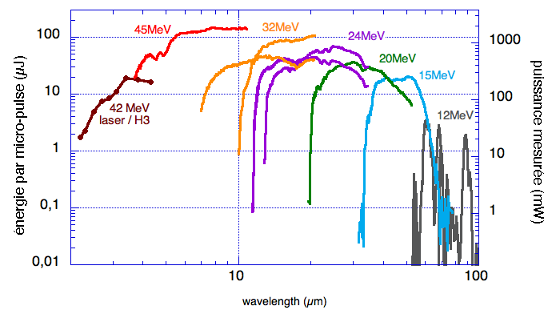
CLIO operates with an electron accelerator (radio-frequency linear accelerator). The full spectral range of CLIO is covered in several segments, each corresponding to a specific electron beam energy: from 45 MeV to 12 MeV (see accelerator specifications at the bottom of the page).

CLIO Performance

Spectral range λ 5 µm to 150 µm = 66 cm-1 to 2000 cm-1
Spectral width ∆λ/λ : ≅ 1%
Pulse duration 1 to 10 ps
Peak Power 10 MW to 100 MW

Temporal structure of pulses:

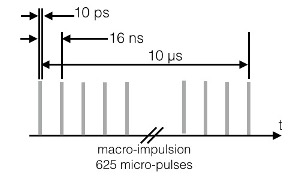
Macro-pulses of ∆t = 10 µs at a rate of 25 Hz

Micro-pulses of δt = 10 ps separated by 16 ns

Laser energy :
average 1 to 2 J per seconde
macro-pulse 40 mJ
micro-pulse 65 µJ
Laser power :
average 1 to 2 W
macro-pulse 4 kW
micro-pulse 6 MW

Spectral range of the CLIO laser for various electron beam energies (12 to 45 MeV). The 2-4 µm range operates on the 3rd harmonic of the undulator.

Specifications of the CLIO Electron Accelerator

Energy Range 12 to 45 MeV
Charge / micro-pulse 1 nC
Peak Current 50 A (in 10 ps micro-pulse)
Average Current 80 mA (in10 µs macro-pulse)
Emittance 200 π mm.mrd (90% of electrons)
RF Frequency 3 GHz
Pre-buncher Frequency 500 MHz
Gun Type thermoionic

Smith-Purcell Radiation Measurement (Nicolas Delerue, IJClab)

The work on coherent Smith-Purcell radiation within the accelerator group at IJCLab investigates how it can be used to measure the longitudinal profile of electron bunches. For this purpose, a detector to measure this radiation was developed and installed at the CLIO accelerator. When an electron bunch passes near a metallic diffraction grating, it induces a current in the grating. Oscillations of this current on the grating surface lead to radiation emission. If the bunch is shorter than the emitted wavelength, the radiation will be more coherent and much more intense. Measuring the coherent Smith-Purcell radiation allows for the determination of the bunch's length and longitudinal profile.