

Principle of FEL
A laser is an amplifier of electromagnetic waves. The principle of a Free Electron Laser (FEL) differs from traditional lasers. The FEL uses an electron beam with electrons that are not bound to atoms — hence the term "free." Thus, laser light is not produced by previously excited atoms but by "synchrotron radiation" emitted by electrons accelerated to nearly the speed of light. This type of radiation is generated when high-energy electrons follow a curved trajectory. This path is imposed by a magnetic field, which is sinusoidal and periodic in the case of the FEL. This sinusoidal magnetic field is achieved using an “undulator,” which consists of two rows of juxtaposed permanent magnets, between which the electron beam passes.
The figure below shows the two rows of magnets (in red), each with a total length of 2 meters. Between these two “jaws,” one can see the vacuum chamber (gold-colored, held by a black bar) through which the electron beam passes. Note that in this photo, the two undulator jaws are exceptionally spaced far apart; normally, they are very close to the vacuum chamber to maximize the magnetic field on the electrons’ path. The electrons interact with the undulator's magnetic field and spontaneously emit photons, which constitute the "synchrotron radiation."

Undulator
An additional phenomenon enables the optical amplification of this radiation due to "energy coupling," allowing electrons to transfer part of their kinetic energy to the radiation. This coupling is facilitated by the transverse velocity component imparted by the undulator's magnetic field.
Like in a conventional laser, this undulator is placed between two parallel mirrors that trap the emitted radiation and enable amplification with each round trip of light in the optical cavity, achieving the intensity level known as “saturation” characteristic of laser action.
The temporal structure of the electron accelerator dictates that of the FEL laser. It thus produces very short micro-pulses (typical duration δt of 1 to 10 picoseconds), temporally spaced by the round-trip time ∆t = 2L/c within the optical cavity — that is, the distance L between its two mirrors (typical duration ∆t of about 10 nanoseconds).
The laser light thus produced is very intense and has all the characteristics of "laser" light in terms of longitudinal and transverse coherence. Additionally, a major advantage of this type of laser is its natural tunability over a vast range (several decades). Indeed, the wavelength of this laser radiation depends solely on the electron energy and the undulator's magnetic field characteristics.
Finally, the operating principle of these FEL lasers applies to all spectral ranges: from Terahertz waves to the X-ray domain, including infrared, which is CLIO's operating range. All this makes this type of laser very versatile and highly useful in research applications.
Schematic Diagram
Electrons are produced in a linear accelerator. After being accelerated in radio-frequency (RF) cavities and focused by quadrupoles, electrons reach the undulator with energy levels ranging from 10 to 45 MeV.
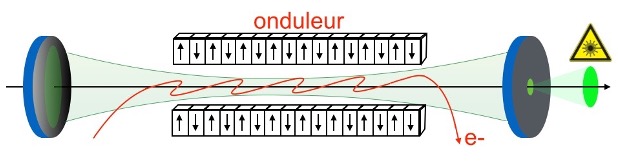
FEL Cavity with Undulator Positioned Between Two Optical Cavity Mirrors
The undulator consists of two jaws, each made up of a series of permanent magnets producing a sinusoidal magnetic field along the propagation axis, to oscillate electrons transversely.
This allows coupling between electrons and the laser wave within the undulator, leading to an optical gain effect on the laser. The laser energy is stored and then amplified in a conventional optical cavity consisting of two mirrors. The wavelength can be easily adjusted by mechanically altering the gap between the jaws or by changing the electron energy from the accelerator.
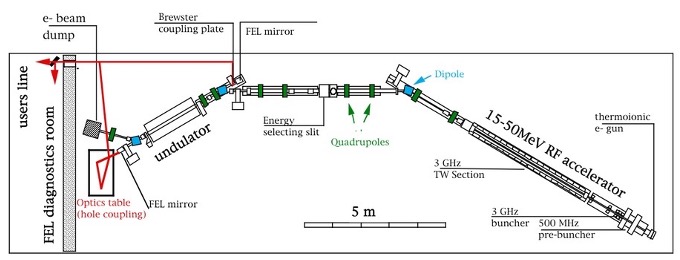
CLIO Laser Setup (Top View)
CLIO Installation Diagram
The electron accelerator is located on the right side of the diagram, with electrons moving from right to left. It includes a cathode ("thermo-ionic e-gun") emitting electrons, followed by a bunching section. The accelerator produces micro-pulses of approximately 101010^{10}1010 electrons (equivalent to 1 nC) over a duration of about 10 ps. The acceleration section allows reaching “relativistic” energies up to E=45E = 45E=45 MeV (where the electron speed is nearly the speed of light).
After a first angular deflection using a magnetic dipole, electrons are energy-filtered through a slit to retain only those with energies close to the nominal energy. A second angular deflection directs the electron beam into the FEL’s optical cavity, where it traverses the undulator. A third angular deflection extracts the electrons from the FEL cavity and sends them to an electron absorber. Beam focusing along the axis is ensured by magnetic quadrupoles installed along the accelerator and the transport line to the absorber.
CLIO's Specific Features
Since its construction, CLIO's performance has been continuously improved. Modifications have lowered the operating energy to approximately 12 MeV, necessary to achieve longer wavelengths. The undulator's vacuum chamber has been replaced to minimize diffraction losses and is designed to function as a waveguide in the far-infrared range (beyond 50 μm). The undulator itself was also modified, increasing its period from 40 to 50 mm to maintain tunability at a given energy. More broadly, enhancements to the optical cavity have extended the spectral range in the far-infrared from 5 µm to 150 µm.
Operation of the Electron Accelerator
Accelerators were originally invented to produce energetic particles for probing atomic nuclei. They are now used for exploring various aspects of particle physics. Their function is to accelerate particle beams using electric fields and guide/focus these beams using magnetic fields. Accelerators are categorized into two types: linear accelerators (where beams travel in a straight line) and circular accelerators (where beams circulate in loops). CLIO belongs to the linear accelerator category.
The main components of an accelerator include:
-
-
-
-
-
-
-
- Klystron: Amplifies the RF wave that accelerates the electrons.
- RF Cavities: Contain the electric field of the RF wave that accelerates the particle beam. Part of the RF wave’s energy is transferred to the particles.
- Vacuum Chamber: A tube in which the particle beam travels, maintained under a high vacuum to avoid collisions with residual air molecules.
- Magnets: Serve various functions, such as dipole magnets for bending the electron trajectory and quadrupole magnets for focusing the electron beam, much like cylindrical lenses focus light beams.
-
-
-
-
-
-